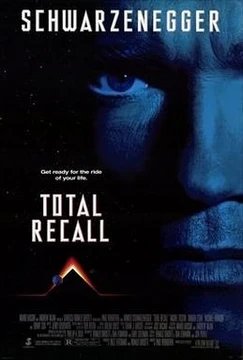
Recall
Sell a man a dream, and the whole world becomes his enemy.

Rekall is the enigmatic memory-implantation enterprise that sits at the narrative heart of both Total Recall films. Marketed as a consumer service for anyone who craves an adventure they will never actually live, it promises to wire a complete, vivid experience—most famously a journey to Mars—directly into the customer's mind. What presents itself as a glossy, almost tourist-trap business quickly unravels into something far more dangerous, making Rekall the fulcrum around which both stories pivot.
In the 1990 Paul Verhoeven original, Rekall doubles as a covert front for the Martian resistance, and the seemingly routine implantation session that goes sideways for Douglas Quaid sets the entire espionage thriller in motion. The 2012 Len Wiseman remake reimagines the premise with a different twist, but retains Rekall as the threshold between the ordinary world and the conspiracy that shatters the protagonist's identity.
- Type
- Memory implantation company (consumer-facing)
- First appears
- Total Recall (1990)
- Also featured in
- Total Recall (2012)
- Core service
- Implanted simulated adventure memories (e.g., Mars trip)
- 1990 hidden role
- Front for a Martian resistance network
- Key operator (1990)
- Benny
Lore & Background
Rekall operates on a deceptively simple commercial premise: for a fee, a customer sits in a reclining implantation chair, a technician wires a small device to the back of their skull, and they walk out carrying a fully formed memory of an experience they never physically had. The 1990 film frames this as a near-future luxury, the kind of service a middle-class homeowner might splurge on after a long week on the factory floor. The office is deliberately mundane—fluorescent lighting, a bored front-desk clerk, a menu of adventure packages laminated on the wall—so that the extraordinary nature of what is being sold feels almost banal.
That banality is the point. In the 1990 story, Rekall's true function is to funnel genuine resistance operatives through a cover that looks like a consumer clinic. The implantation machine is not merely a dream-box; it is a tool for overwriting, reinforcing, or extracting memories under the guise of a routine procedure. When Douglas Quaid's session malfunctions—or appears to malfunction—the line between a sold dream and a buried truth dissolves, and the company's employees become either his allies or his pursuers depending on which side of the reveal the audience is on.
The 2012 remake keeps the consumer-service shell but retools the conspiracy beneath it, shifting the stakes and the nature of the implanted experience. In both versions, Rekall endures as a symbol of how memory, identity, and reality can be commodified, questioned, and weaponized by the same institution that sells you a postcard of a place you've never seen.
In Their Own Story
The fluorescent tubes in the Rekall lobby hum at a frequency that makes your molars ache. You sign the liability waiver with a ballpoint that clicks too loud, and the woman at the desk—Benny, if you're in the 1990 version—doesn't even look up. "Mars, standard package," she says, sliding a form across the counter. "Two weeks of memory. Sunsets, canyons, the whole thing. You'll remember it like it happened. You just won't remember where you were when it happened."
You lie back in the chair. The gel on the electrode pad is cold. A technician taps a key, and the ceiling tiles dissolve into rust-colored sky. You smell iron dust. You feel wind you will never feel again. And somewhere behind the hum of the machine, a door you didn't notice clicking open lets in a man in a dark coat who is already looking for you, because the memory they're about to implant is not a package at all—it is a key, and you are the lock.
Reader's Guide
What the 1990 film shows on screen: a small, brightly lit office with a reception desk, a menu of adventure packages, a reclining chair with an electrode apparatus, and a technician (Benny) who runs the session with practiced, almost bored efficiency. Quaid sits down, the machine activates, and the session visibly goes wrong—sparks, a scream, a door bursting open. The audience sees the consumer-facing side and then immediately the violent, conspiratorial side.
What is stated in dialogue: characters explain that Rekall sells "memories" of experiences, and that the implantation is a one-time procedure. Later, the truth that Rekall is a resistance front is revealed through conversation among the characters, not through exposition to the audience.
What is left to inference: the full scope of Rekall's operations, how many other "customers" were actually operatives, and whether the memory-implantation technology is unique to this company or a broader industry. The films never give a corporate history, a founding date, or a regulatory framework. The audience is asked to accept that a service this extraordinary sits in a building with a parking lot, and that the line between a sold dream and a planted secret is thinner than a single electrode wire. The 2012 remake preserves the office setting and the basic service model but recontextualizes the conspiracy, so the "inferred" layer shifts accordingly.
Did You Know?
- In both the 1990 original and the 2012 remake, the company name is spelled with a K—Rekall—distinguishing it from the ordinary English word and giving it a slightly off-brand, corporate feel.
- The 1990 film's revelation that Rekall is a front for the Martian resistance recontextualizes every earlier scene in the office, turning the bored clerk and the laminated menu into pieces of a spy operation.
- The memory-implantation chair and electrode apparatus became an instantly recognizable visual shorthand for the film, frequently referenced in fan art and cosplay even decades after release.
- The consumer-service framing—treating a potentially world-altering memory procedure like a dentist's appointment—was a deliberate tonal choice that contrasted the high-stakes conspiracy with mundane bureaucracy.
More in Lore & History
Elsewhere in the Total Recall universe
Spotted an error? Know more?
This is a living reference — every entry is fact-audited, and reader corrections feed straight into our audit queue. Suggest an edit · See this site's audit record