We Can Remember It for You Wholesale
Your past is a product, your dreams are a SKU, and Rekall sells both by the pallet.

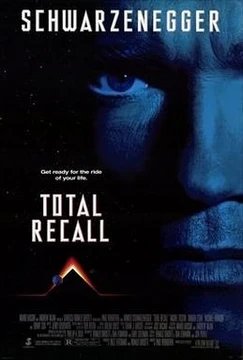
"We Can Remember It for You Wholesale" is the advertising slogan of Rekall, the memory-implantation corporation at the heart of the 1990 sci-fi film Total Recall. It functions as both a hook and a thematic thesis: in a world where identity is malleable and experience can be purchased off a menu, the tagline promises that the most precious human commodity—lived memory—can be acquired in bulk, cheaply, and without the inconvenience of actually living it. The line is the film's most quoted phrase and the narrative engine that drags its protagonist, Douglas Quaid, into a conspiracy that blurs the line between implanted fantasy and buried truth.
The slogan is a deliberate expansion of Philip K. Dick's 1966 short story title, "We Can Remember It for You." The addition of "Wholesale" transforms a personal, almost tender service into a mass-market commodity, and that tonal shift is exactly the satirical edge Paul Verhoeven's film leans into: your dreams are a product, your past is a SKU, and your sense of self is just another item on the Rekall catalog.
- Source
- 1990 film Total Recall (dir. Paul Verhoeven)
- Company
- Rekall (memory-implantation service)
- Protagonist
- Douglas Quaid (Arnold Schwarzenegger)
- Literary origin
- Philip K. Dick short story 'We Can Remember It for You' (1966)
- Thematic role
- Central conceit—identity as purchasable commodity
- Setting
- Neo-Tokyo / Mars colony (dystopian near-future)
Lore & Background
In the world of Total Recall, Rekall operates out of a gleaming, almost sterile facility in a crowded megacity. Clients walk in, browse a catalog of experiences—Mars heists, exotic romances, daring rescues—and walk out with the vivid, sensory-rich memory of having lived them. The tagline "We Can Remember It for You Wholesale" hangs above the counter like a department-store sign, reducing the architecture of selfhood to a transaction. The service is marketed as harmless escapism, a way to scratch an itch you never knew you had, and the film's first act treats it exactly that way: a bored factory worker saves up, books a slot, and prepares to enjoy a weekend on Mars in his head.
The deeper lore, however, is that Rekall is not merely a novelty shop. The memories it implants are sophisticated enough to be indistinguishable from genuine recollection, and the company's true business—suggested by the film's escalating conspiracy—may involve overwriting real memories to hide people, missions, or entire identities. The word "Wholesale" takes on a darker resonance: not just "in bulk" but "in a way that erases the original," as in a wholesale replacement. The tagline becomes a warning dressed as an invitation.
For fans, the slogan endures because it crystallizes the franchise's central anxiety in a single, punchy sentence. It asks: if your memory of a life can be manufactured, sold, and swapped, what is actually yours? The question is as relevant in a streaming-age world of curated identities as it was in 1990, which is why the line still gets quoted in film-history discussions, sci-fi panels, and late-night conversations about what makes a person a person.
In Their Own Story
The Rekall lobby hums with the low thrum of recycled air and the soft chime of a service bell. Douglas Quaid sits in a molded chair, his fingers drumming on his knee, watching a technician slot a thin filament into the temple of a woman across the room. She blinks, smiles, and says, "Mars. I was on Mars. I can still smell the dust." She signs a waiver, tips the tech, and walks out into the grey megacity drizzle, already half-remembering a sunset she will never see.
Quaid's turn comes. The technician's voice is flat, practiced: "Standard Mars package? Heist, romance, the works?" Quaid nods. The filament goes in. For a moment, nothing. Then the smell of red dust floods his nostrils, and a woman's laugh—Linda's, maybe, or maybe someone else entirely—threads through his skull like a wire being pulled. He grips the armrests. The technician glances up, unbothered. "Wholesale," she murmurs, almost to herself, and stamps his file. The bell chimes. The next client is already in the chair.
Reader's Guide
The film opens in a saturated, overpopulated megacity and introduces Rekall as a consumer service. The audience is invited to accept the premise at face value: memory implants are a novelty, a vacation for the mind. Quaid books a Mars package, and the first act plays almost like a heist-movie setup—tension, a beautiful woman, a job to do. The tagline is the promise that none of this will be real, and the audience leans into that comfort.
The first major shift arrives when Quaid's implanted memory starts bleeding into the present: people recognize him, a gun is pulled, and the "Mars" he was supposed to only remember suddenly has fingerprints on it. The audience is told, implicitly, that the memory may not be a memory. Every earlier scene—the bored factory shifts, the marriage to Lori, the Rekall intake form—recontextualizes. Was any of it real, or was it a wholesale overwrite?
The second shift is the reveal that Quaid may already be on Mars, that the "megacity" he lived in was itself an implanted layer, and that his identity as a factory worker is the fiction. The tagline inverts: Rekall didn't sell him a memory; they were trying to erase one. The audience now re-reads every handshake, every familiar face, as a potential cover story.
The final beat is Quaid choosing—despite the uncertainty, despite the possibility that his entire self is a product on a shelf—to act as if the memories are his. The tagline's commercial language is rejected. He doesn't want it wholesale. He wants it to be true, and he will make it true by living it, even if the universe never intended him to.
Did You Know?
- The film's title adds the word 'Wholesale' to Philip K. Dick's original 1966 short story title 'We Can Remember It for You,' shifting the tone from intimate service to mass-market commodity.
- Rekall's slogan is delivered in-world as a simple advertising tagline, yet it functions as the film's central philosophical question: can a manufactured memory be any less 'real' than a lived one?
- The 1990 film's plot diverges significantly from Dick's short story, which is a brief, ambiguous piece about a couple buying a shared memory; the film expands it into a full action-thriller with a Mars colony, a resistan
- The tagline has become one of the most recognizable one-liners in 1990s sci-fi cinema, frequently quoted in discussions of identity, memory, and the commodification of experience in speculative fiction.
More in Story & Timeline
Elsewhere in the Total Recall universe
Spotted an error? Know more?
This is a living reference — every entry is fact-audited, and reader corrections feed straight into our audit queue. Suggest an edit · See this site's audit record