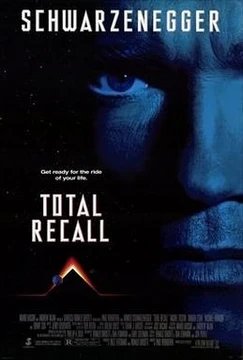
Dan O'Bannon
The man who wrote the most gloriously confusing identity crisis in cinema history.

Dan O'Bannon (1946–2011) was the American screenwriter and producer whose 1990 screenplay for Total Recall transformed Philip K. Dick's short story 'We Can Remember It for You Wholesale' into one of the most ambitious and structurally daring science-fiction films of the decade. Working in close creative partnership with director John Carpenter, O'Bannon crafted the film's layered identity-confusion narrative, its vividly realized Mars colony, and the iconic Rekall memory-implant procedure that became a touchstone of 1990s sci-fi cinema.
Though he is best remembered by fans as the architect of that particular story, O'Bannon's broader body of work—including the original Alien screenplay and The Thing—established him as a defining voice in practical-effects-driven, idea-first genre filmmaking. His Total Recall script remains a masterclass in misdirection, world-building, and the slow unraveling of a protagonist's sense of self.
- Role
- Screenwriter
- Affiliation
- Total Recall (1990) production
- Source Material
- Philip K. Dick, 'We Can Remember It for You Wholesale'
- Notable Works
- Alien (1979), The Thing (1982), Total Recall (1990)
- Status
- Deceased (2011)
Lore & Background
O'Bannon's Total Recall screenplay is a tour de force of narrative misdirection. He took Dick's relatively compact premise—a man who can't remember whether his implanted memories are real or fabricated—and expanded it into a sprawling, two-world epic spanning a dystopian Earth and a sun-scorched Mars colony. The script's genius lies in its refusal to let the audience settle into a single 'truth': every scene is simultaneously a memory and a possibility, and the film's famous twist recontextualizes not just the protagonist's past but the entire visual and tonal grammar the audience has been absorbing for two hours.
Working alongside Carpenter, O'Bannon leaned into the era's appetite for visceral, practical spectacle while never letting the set-pieces outpace the psychological core. The Rekall procedure, the Martian resistance, the villainous Quaid/Hauser duality, and the film's deliberately ambiguous ending all reflect a writer who understood that the audience's confusion was the point. His collaboration with Carpenter—forged earlier on The Thing—produced a chemistry where Carpenter's visual restraint and O'Bannon's structural complexity reinforced each other.
O'Bannon's broader career cemented his reputation as a filmmaker who trusted the audience to follow complex, morally ambiguous narratives. From the claustrophobic terror of Alien to the paranoia of The Thing and the identity labyrinth of Total Recall, his work consistently asked viewers to question what they thought they knew, a sensibility that made his Total Recall script feel both of its moment and endlessly rewatchable.
In Their Own Story
The Rekall chair hums its low, oily thrum. Around the edges of the room, the other customers sit in their own pods, eyes closed, faces slack with borrowed lives. But in the center chair, a man in a rumpled work jacket grips the armrests as the technicians snap the final electrodes into place. The smell is antiseptic mixed with something sweeter, almost floral, like ozone after a storm. A woman in a white coat checks her tablet, murmurs to her assistant, and the lights dim to a deep arterial red. The man's eyelids flutter. Somewhere behind his teeth, a memory that isn't his is already taking root—sunlight on rust-colored dunes, the taste of a woman's laugh, the crunch of a boot on Martian gravel. He doesn't know yet that in six hours he will either be a man who remembers a life he never lived, or a man who has forgotten the only one he did. The chair reclines. The hum deepens. The world outside the glass wall—grey, dripping, endless—ceases to matter.
Reader's Guide
O'Bannon structures Total Recall as a three-act identity collapse, and the audience's understanding shifts at each seam.
Act One establishes the 'normal' world: the Rekall procedure, the domestic life, the first Martian memory. The audience is invited to accept the memory as a fun fantasy. The shift comes when the memory resists being a memory—Quaid's wife is hostile, the world feels wrong, and the first 'reality' begins to crack. The audience now suspects the implanted story might be real.
Act Two doubles down on the Martian world, which is richer, more dangerous, and more emotionally resonant than the Earth. The audience is now emotionally invested in the 'false' world. The midpoint shift—Quaid's capture, the revelation that he may be Hauser, a government agent—recontextualizes every Martian scene as potentially a cover story. Nothing the audience saw can be trusted.
The third act and the famous ending refuse to resolve cleanly. O'Bannon withholds the final confirmation, leaving the audience in the same epistemic uncertainty as the protagonist. The 'recall' conceit means every earlier scene is simultaneously a memory and a fabrication, and the audience must re-experience the entire film in their head, questioning which layer was the 'real' one. The structure is the theme: identity is not a fixed point but a story you tell yourself, and the story can be rewritten.
Did You Know?
- Dan O'Bannon's Total Recall screenplay expanded Philip K. Dick's roughly 10-page short story into a full two-hour feature with an entirely new second world (Mars) and a dual-protagonist structure not present in the origi
- O'Bannon and John Carpenter had previously collaborated on The Thing (1982), and their shared philosophy of practical effects and audience-trust carried directly into Total Recall's production design and narrative struct
- The film's deliberately ambiguous ending—where the audience is never fully told whether Quaid's Martian memories are real or implanted—was a deliberate choice by O'Bannon to mirror the protagonist's own uncertainty, maki
- O'Bannon's earlier screenplay for Alien (1979) established his signature of building horror and wonder through confined, detail-rich environments—a sensibility visible in the tight, procedural Rekall scenes of Total Reca
More in Story & Timeline
Elsewhere in the Total Recall universe
Spotted an error? Know more?
This is a living reference — every entry is fact-audited, and reader corrections feed straight into our audit queue. Suggest an edit · See this site's audit record