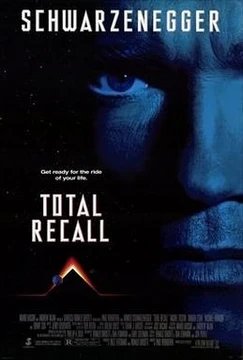
Recall Corporation
Walk in wanting a vacation. Walk out questioning whether you ever existed at all.

The Recall Corporation is the enigmatic, hyper-advanced memory-implantation firm that sits at the heart of the Total Recall universe. In the 1990 Paul Verhoeven film, it presents itself to a desperate, overpopulated Earth as a provider of 'lifestyle' experiences—fully simulated vacation memories grafted directly into a customer's neural architecture. In the 2012 Len Wiseman remake, the company operates as a sleeker consumer-tech brand selling curated dream sequences to the masses. In both tellings, however, the gleaming corporate facade conceals far darker operational purposes, and the company becomes the gravitational center around which the entire plot orbits.
For the audience, Recall is the doorway into the story: the protagonist walks through its glass doors seeking an escape, and what he finds on the other side redefines everything he thought he knew about his own identity. The corporation is simultaneously the setting, the antagonist, and the lens through which the film interrogates questions of memory, identity, and corporate power.
- Type
- Memory-implantation / lifestyle-experience corporation
- Setting
- Earth (1990 film); Earth and Mars (2012 film)
- Key on-screen employee
- Benny (technician, 1990 film)
- First appears
- Total Recall (1990), dir. Paul Verhoeven
- Narrative role
- Central institution; its true purpose drives the plot
- Status in 1990 film
- Revealed as a front for covert Martian operations
Lore & Background
In the 1990 film, Earth is a choking, overpopulated hellscape of smog, noise, and grinding poverty, and the Recall Corporation is one of the few institutions that offers its citizens something that feels like transcendence. The company's public pitch is simple: for a fee, a customer can receive a fully immersive 'lifestyle' memory—a week on a tropical island, a grand adventure, a romance—implanted so seamlessly that it becomes indistinguishable from lived experience. The facility is a cathedral of sterile white corridors, reclining chairs, and humming neural equipment, staffed by technicians like Benny, who guide nervous customers through the intake process with a mix of corporate cheer and clinical detachment.
What the audience gradually learns is that the company's public product is a smokescreen. Behind the glass walls, Recall is manufacturing agents—people whose memories have been surgically constructed so they believe they are members of a Martian resistance fighting an oppressive colonist government. The 'lifestyle' memories are actually combat training, loyalty programming, and identity fabrication, all wrapped in the same neural-implantation technology sold to paying customers. The corporation is, in effect, a factory for manufactured identities, and its true masters operate from Mars.
The 2012 remake reframes the company as a more explicitly consumer-facing tech brand, with a polished marketing aesthetic and a broader product line of 'experiences.' The Mars connection is reworked, but the core conceit remains: Recall sells you a self, and the line between the memory you paid for and the life you actually lived is deliberately, dangerously blurred. In both versions, the corporation embodies the fan-community's central anxiety about the Total Recall world—that identity is not something you are born with but something that can be installed, edited, or overwritten by whoever holds the technology.
In Their Own Story
The elevator banks in the Recall lobby hum with a low, almost subliminal thrum. Through the floor-to-ceiling windows, the city of Los Angeles is a bruise of orange smog and stacked tenements, a million people pressed against the glass like insects on a jar. You peel off your jacket, sign the tablet with a trembling finger, and the technician—Benny, or whoever they call him this time—smiles the exact smile the corporate manual probably scripts. 'Just relax,' he says, 'and let the memory do the remembering.' The chair reclines. The needle finds the base of your skull. And somewhere in the white static behind your eyes, a beach you've never seen starts to smell like salt and sunscreen, and you can't tell if you're remembering it or if it's remembering you.
Reader's Guide
The 1990 film structures its narrative as a slow, spiraling collapse of the protagonist's certainty, and Recall is the hinge on which every turn pivots.
Beat one: Dissatisfaction. Quaid is a factory worker in a suffocating city, and his marriage is fraying. Recall is presented as the one affordable fantasy, a consumer product. The audience is invited to share his wish-fulfillment.
Beat two: The procedure. The 'lifestyle' implant begins, but glitches. Quaid is ejected from the facility, now a fugitive. The audience still believes he was a customer who got a bad product. Recall is the villain by accident.
Beat three: The recontextualization. Quaid is hunted by agents who call him by a name he doesn't know. He meets a woman who says he is a Martian resistance fighter. The 'bad product' framing shatters. Recall was not a consumer company that made a mistake; it was a manufacturing plant that produced him.
Beat four: The full inversion. The audience learns that the memories Quaid has been 'remembering'—the island, the romance, the factory job—were all implanted. His wife, his life, his sense of self are all Recall's handiwork. Every earlier scene is re-read as a product demonstration.
Beat five: The choice. Quaid must decide whether to accept the identity Recall gave him or to forge one through action. The corporation's power depends on the customer's willingness to believe the memory is real. The film's final act is Quaid choosing to act rather than remember, breaking the loop Recall was designed to enforce.
The 'recall' conceit thus functions as a narrative Rorschach test: the audience, like Quaid, keeps reinterpreting every prior scene each time the corporation's true purpose peels back another layer.
Did You Know?
- The 1990 film's story is widely understood to draw on Philip K. Dick's short fiction exploring implanted memories and manufactured identity, though the film expands the premise into a full corporate-thriller structure.
- The 1990 film was released in two distinct cuts—the theatrical version and a director's cut with additional scenes and a different tonal emphasis—giving fans two slightly different readings of Recall's role and the endin
- In the 1990 film, the Recall facility's public-facing 'lifestyle' product and its covert agent-manufacturing operation use the same underlying neural-implantation technology, meaning the consumer experience and the milit
- The 2012 remake reimagines Recall with a more explicitly consumer-tech and marketing-driven aesthetic, shifting the corporate tone from the 1990 film's industrial-cold design toward a sleeker, almost Silicon-Valley visua
More in Story & Timeline
Elsewhere in the Total Recall universe
Spotted an error? Know more?
This is a living reference — every entry is fact-audited, and reader corrections feed straight into our audit queue. Suggest an edit · See this site's audit record