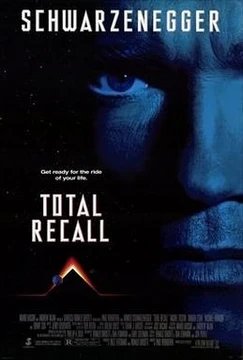
Mars Map
No implant can hide what the ground itself remembers.

The Mars Map is a navigational schematic referenced in Total Recall (1990) that points to the location of the hidden underground colony beneath the Martian surface. It functions as a narrative key: the thing Quaid is searching for, the thing the antagonists want to suppress, and the thing that ultimately reveals the truth about where the real Martian settlement actually lives. In a film built on the question of what is real and what is implanted, the map becomes a symbol of objective truth that no memory procedure can erase.
While it is not a standalone gadget with a product name, the map (or series of maps and coordinates) threads through the second act of the film as the MacGuffin that drives Quaid, Ben, and the resistance toward the subterranean city. Its existence underscores the film's central tension: a world where governments and corporations can rewrite a person's past, but geography and physical reality remain stubbornly, verifiably real.
- First appears
- Total Recall (1990)
- Function
- Reveals the location of the underground Martian colony
- Narrative role
- MacGuffin / key to the hidden settlement
- Associated characters
- Douglas Quaid, Ben, the Martian resistance
- Setting
- Mars (underground colony region)
- Thematic link
- Objective truth vs. manufactured memory
Lore & Background
In the architecture of Total Recall, the Mars Map sits at the intersection of espionage, survival, and the search for self. The film's first act is dominated by Rekall's memory parlor, where Quaid's entire sense of identity is constructed and deconstructed in a single afternoon. The Mars Map, by contrast, is something outside the mind: a fixed set of coordinates, a physical layout that does not shift when someone's memories are rewritten. When Quaid begins to suspect that his 'Mars memories' are implanted, the map becomes his anchor to something he can verify with his own eyes and feet.
The resistance fighters on Mars treat the map with the reverence of a sacred text. In a world where the surface government projects an image of a thriving colony while the true settlement hides in the caverns below, knowing where to dig is knowing where the truth lives. The map is not merely a tool; it is proof that the underground city is real, that the people in it are real, and that the narrative sold to the surface population is a fabrication as constructed as any Rekall implant.
The film uses the map to dramatize a simple but powerful idea: you can implant a memory of a place, but you cannot implant the place itself. The Mars Map is the one artifact in the story that resists the logic of the Rekall machine. It cannot be 'remembered into existence' or 'forgotten away.' It is, in the film's taxonomy of truth, the hardest kind of evidence there is.
In Their Own Story
The dust on Mars is red so deep it looks almost black in the low light. Quaid crouches in the trench, his fingers tracing the creased schematic Ben pressed into his palm an hour ago. The coordinates are simple—three lines of numbers, a depth reading, a bearing. But they are the most dangerous numbers on the planet. Above him, the surface wind howls across the rust-colored flats, carrying the faint hum of a patrol drone. He folds the map back into his jacket, feels the crease against his ribs like a second heartbeat, and begins to dig. The ground gives way in chunks of oxidized clay, and somewhere far below, he knows, a city is waiting to be found. He does not need to remember it. He only needs to reach it.
Reader's Guide
The Mars Map operates on a principle that the rest of the film's technology inverts. Rekall can write, overwrite, and delete a person's memories of a place, but the map simply points to where that place actually is. It is controlled by the Martian resistance, who treat it as both a navigational tool and a piece of evidence against the surface authority. In the film's logic, the map is the one thing that cannot be 'implanted'—it must be found, stolen, or earned through physical action.
This creates a sharp contrast with the Rekall procedure, where identity is a product you purchase and a corporation can revoke. The map demands nothing of the mind; it demands the body. You must walk, dig, and verify. In a story obsessed with whether Quaid is a spy, a dreamer, or a man who had a bad afternoon at a memory parlor, the map is the one fact that no amount of psychological manipulation can dissolve.
The map also serves the film's exploration of bodily autonomy. The Rekall machine treats the brain as a storage drive to be formatted. The map, by contrast, treats the body as the only reliable instrument of truth: your feet on the ground, your hands in the dirt, your eyes confirming what the coordinates promised. If you can stand in the underground city and breathe its recycled air, no implanted memory can argue with that.
For the audience, the map works as a visual shorthand for the film's central question: when every other layer of reality is suspect, what is left? The answer Total Recall offers is deceptively simple—go look. The map is your permission to do so.
Did You Know?
- The underground Martian colony in Total Recall was one of the most ambitious practical sets of its era, built to feel like a lived-in community rather than a sci-fi diorama.
- The film's Rekall memory-implantation procedure was designed to visually echo a surgical theater, reinforcing the idea that identity is something done to you by a technician.
- Total Recall's Mars sequences were shot on location and with extensive practical effects, giving the rust-colored landscape a tactile, gritty quality distinct from the sterile Rekall parlor.
- The film's central conceit—that a person's entire past could be a product purchased at a parlor—predates modern discourse on deepfakes and fabricated media by more than three decades.
More in Technology & Artifacts
Elsewhere in the Total Recall universe
Spotted an error? Know more?
This is a living reference — every entry is fact-audited, and reader corrections feed straight into our audit queue. Suggest an edit · See this site's audit record